
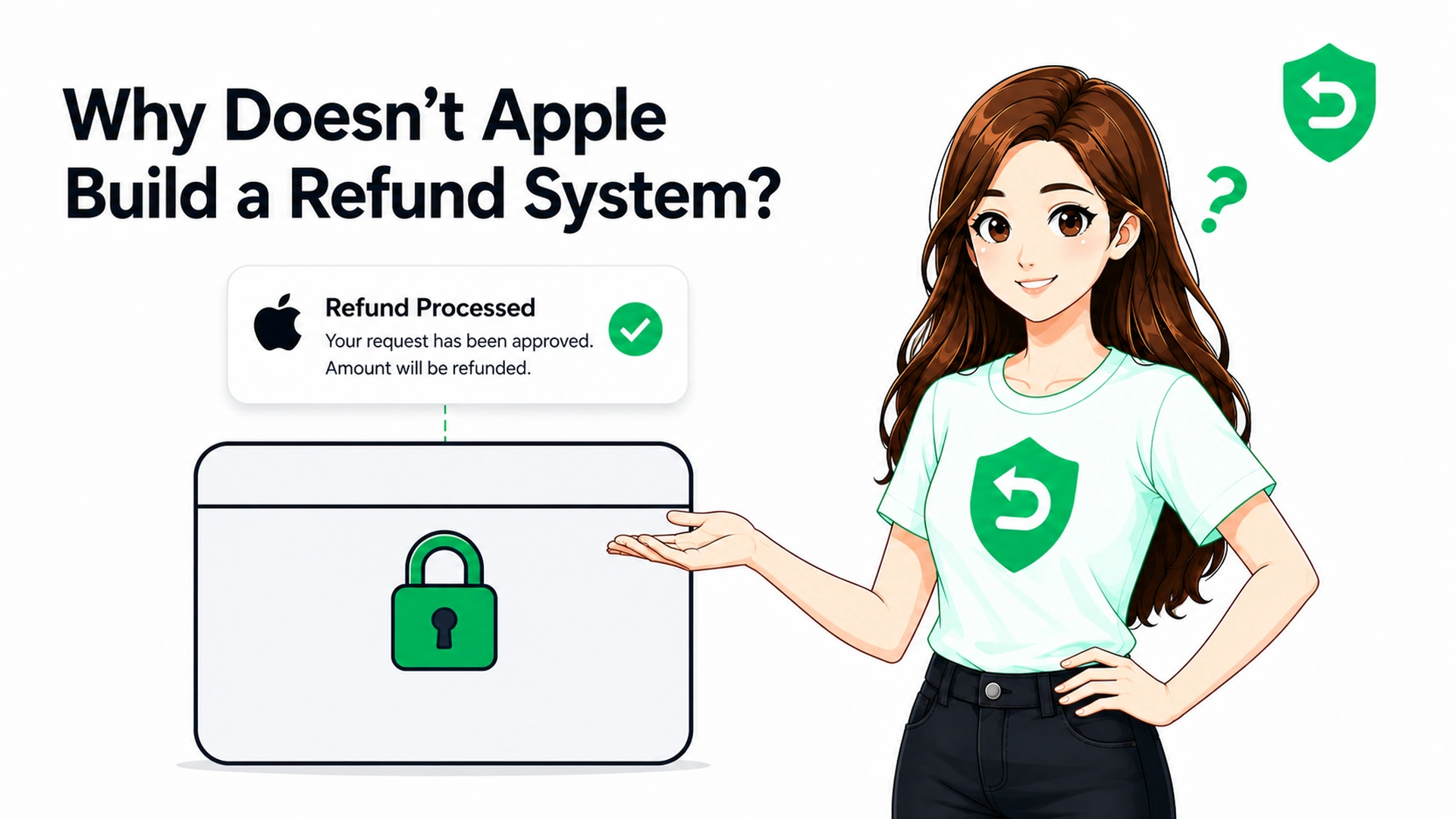
Apple already offers a refund process, yet many users still wonder why refunds aren't more automated. This article explores how Apple's refund system works, why it relies on manual review, and the business and technical reasons behind that decision.
If you sell an app or a subscription on the App Store, you have probably asked one blunt question. Why does not Apple build a system for handling refunds that developers can actually run? You watch the money leave your account. You get almost no say in it. The whole thing feels like a locked box.
Here is the honest answer up front. Apple does have a refund system. It just is not built for you. It is built for the buyer. If you want to see how that gap hits your revenue, our Apple refund defense breakdown shows where the money quietly goes.
This article is not another "how to get an Apple refund" guide. It looks at why Apple designed the Apple refund model this way, and why the company keeps refund power to itself instead of handing developers the wheel.
Quick answer: Apple does not build a developer-run refund system on purpose. It runs one central, buyer-first system through Report a Problem so the experience stays the same across every app. Developers can send data on some requests, but Apple always makes the final call.
Key Takeaways
Apple runs a refund system for buyers, not a control panel for developers.
Buyers file an Apple refund request through Report a Problem, and Apple reviews it.
Developers get a short window to send data on some purchases, and nothing more.
Apple keeps the final call to protect buyer trust, cut fraud, and stay legally safe.
That gap is the reason third-party refund tools exist at all.
What Is Apple's Refund System?
Apple's refund system is a central process. The customer asks Apple for the money back, and Apple decides. The developer is mostly a bystander. That is the short version, and it matters for everything below.
On the buyer side, Apple points people to reportaproblem.apple.com. A customer signs in, picks "Request a refund," chooses a reason, and submits. Apple then reviews the Apple refund request against its own rules. This is documented in Apple Support.
Here is the part people miss. The Apple refund policy is not a fixed public rulebook with hard guarantees. Apple says purchases "might be eligible" for a refund and that eligibility can vary by region. So an App Store refund is a review, not a vending machine.
How Does Apple's Refund Process Work?
The Apple refund process has two sides that rarely meet: the buyer's side and the developer's side.
The buyer side
The customer signs in to reportaproblem.apple.com.
They pick "Request a refund" and choose a reason.
They select the app, subscription, or item and submit.
Apple reviews the claim, usually within 24 to 48 hours.
If approved, the money returns to the original payment method. Store credit can post in 48 hours, while card refunds can take up to 30 days.
The developer side (documented)
For some purchases, Apple sends your server a CONSUMPTION_REQUEST through App Store Server Notifications. You get roughly 12 hours to reply with consumption data using the Send Consumption Information endpoint. Our guide to the CONSUMPTION_REQUEST notification walks through each field. But even a perfect reply is only input. Apple still makes the decision.
Why Doesn't Apple Build a System for Handling Refunds?
Direct answer: Apple already built a refund system, but it deliberately does not give developers one to control. Central control is the point, not an oversight. It keeps the buying experience the same across every app on the store.
Think about it from Apple's seat. Millions of apps sit on the App Store. If every developer set their own refund rules, buyers would face a different fight in every app. One studio would auto-deny everything. Another would stall. Apple's whole pitch is "buy with confidence," so it owns the decision to protect that promise.
There is a developer ecosystem angle too. If Apple gave every studio full refund control, it would need to police millions of custom refund policies for abuse and fairness. That is a support and trust nightmare. By keeping one system, Apple keeps the rules predictable for the buyer and keeps itself out of a million small disputes between users and developers.
This is also why the developer tools stay thin on purpose. You can send data. You cannot overrule Apple. The table below shows how this compares with Google Play.
Aspect | Apple App Store | Google Play |
|---|---|---|
Where the buyer asks | Google Play or Google support | |
Developer signal | CONSUMPTION_REQUEST notification | Voided Purchases API and RTDN |
Response window | About 12 hours | About 24 hours for chargeback review |
Who decides | Apple | |
Developer control | Send data only | Send data only |
Table 1: Apple vs Google Play refund workflow. Both stores keep the final decision in-house.
Business Reasons Behind Apple's Refund Model
The following is my analysis as a founder who has studied this, not Apple policy. Apple's choices line up with clear business logic.
Trust is the product: A smooth refund keeps buyers spending across the whole store, not just one app.
One experience at scale: A single refund flow is easier to run than millions of custom ones.
Legal cover: Consumer laws differ by country. Apple centralizes so it can stay compliant in each region.
Platform power: Owning refunds keeps Apple in control of the money flow and the relationship with the buyer.
Support savings: Buyers blame Apple, not you, which keeps the store feeling safe.
Technical Challenges of Handling Refunds
There is also a hard engineering reason Apple does not simply hand this off. Handling refunds well at Apple's scale is genuinely messy. This section is analysis grounded in how the APIs behave.
Volume: Billions of transactions across regions and currencies need one consistent rulebook.
Consumables: Coins or credits may already be spent, so "give it back" is not simple.
Shared accounts: Family Sharing and multiple Apple Accounts blur who actually paid.
Entitlements: Revoking access the instant a refund clears is hard to coordinate across every developer's server.
A full developer-run system would need all of this to work perfectly on every server on the store. Apple chose to keep the logic in one place instead.
Fraud Prevention and Developer Protection
Central control is also a fraud shield, and this cuts both ways. If developers could auto-deny every claim, honest buyers would get burned. If buyers could auto-approve everything, refund farmers would drain revenue. Apple sits in the middle as the referee.
The catch is that the referee moves fast. Miss the reply window and the claim is settled without your input. Our breakdown of the Apple refund response window explains why so many teams lose winnable cases by simply not answering in time. Handling refunds is less about arguing and more about showing up before the clock runs out.
What Apple Could Improve
This section is my opinion, offered as constructive analysis. Apple's model is defensible, but developers are left with real blind spots. Here is the gap between what exists and what a fairer system might look like.
Feature | Apple's Current System | A More Developer-Friendly System |
|---|---|---|
Final decision | Apple decides alone | Apple decides with clearer rules |
Developer input | Data within about 12 hours | Real-time dashboard plus set policies |
Visibility | Very limited | Full refund analytics |
Automation | Build it yourself | Native, reliable automation |
Notifications | Easy to miss | Hard-to-miss alerts |
Table 2: Current refund system vs an ideal developer-facing system (author analysis).
Subscriptions make this gap sharper. A refund on an auto-renewable subscription can claw back revenue you already counted, and the user experience shapes whether that happens. When people cannot find the cancel button, they hit "request a refund" instead, and the developer eats the loss. Better in-app cancel flows and honest paywalls quietly reduce refund pressure, but Apple does not surface that link for you. You have to connect it yourself from the refund reasons Apple shares.
None of this means Apple is wrong. It means the current setup leaves money and clarity on the table for developers, and that space is exactly where dedicated tools step in.
Conclusion
So, why does not Apple build a system for handling refunds? Because it already did, and it built the one it wanted: a buyer-first system that Apple controls end to end. The Apple refund process is centralized on purpose, for trust, for scale, for law, and for fraud control.
For developers, the takeaway is simple. You will not get the keys to Apple's refund system any time soon. What you can do is stop losing the cases you could win, by answering every request with real data before the window closes. That is the layer Apple leaves to you, and it is worth owning.
Stop losing cases you could win. RefundSensor answers every Apple CONSUMPTION_REQUEST automatically inside the 12-hour window with real data from your app, no code changes, no SDK. Start free
Frequently asked questions
Yes. Apple has a refund system through Report a Problem, where customers can request refunds for eligible purchases. Apple reviews each request based on its refund policy and makes the final decision. Developers cannot approve or reject refund requests.
Visit reportaproblem.apple.com, sign in with your Apple ID, select Request a Refund, choose the purchase and reason, then submit your request. Apple reviews the request and notifies you of the outcome.
Apple manages refunds to provide a consistent customer experience, reduce fraud, and comply with regional consumer protection laws. Developers can provide limited information for some requests, but Apple makes the final decision.
No. Developers cannot approve or deny Apple refund requests. For some purchases, Apple may request usage information from developers, but the final refund decision is always made by Apple.
A CONSUMPTION_REQUEST is a notification Apple sends to developers asking for usage information about a purchase. Developers have a limited time to respond, and Apple may use that information when deciding whether to approve a refund.