
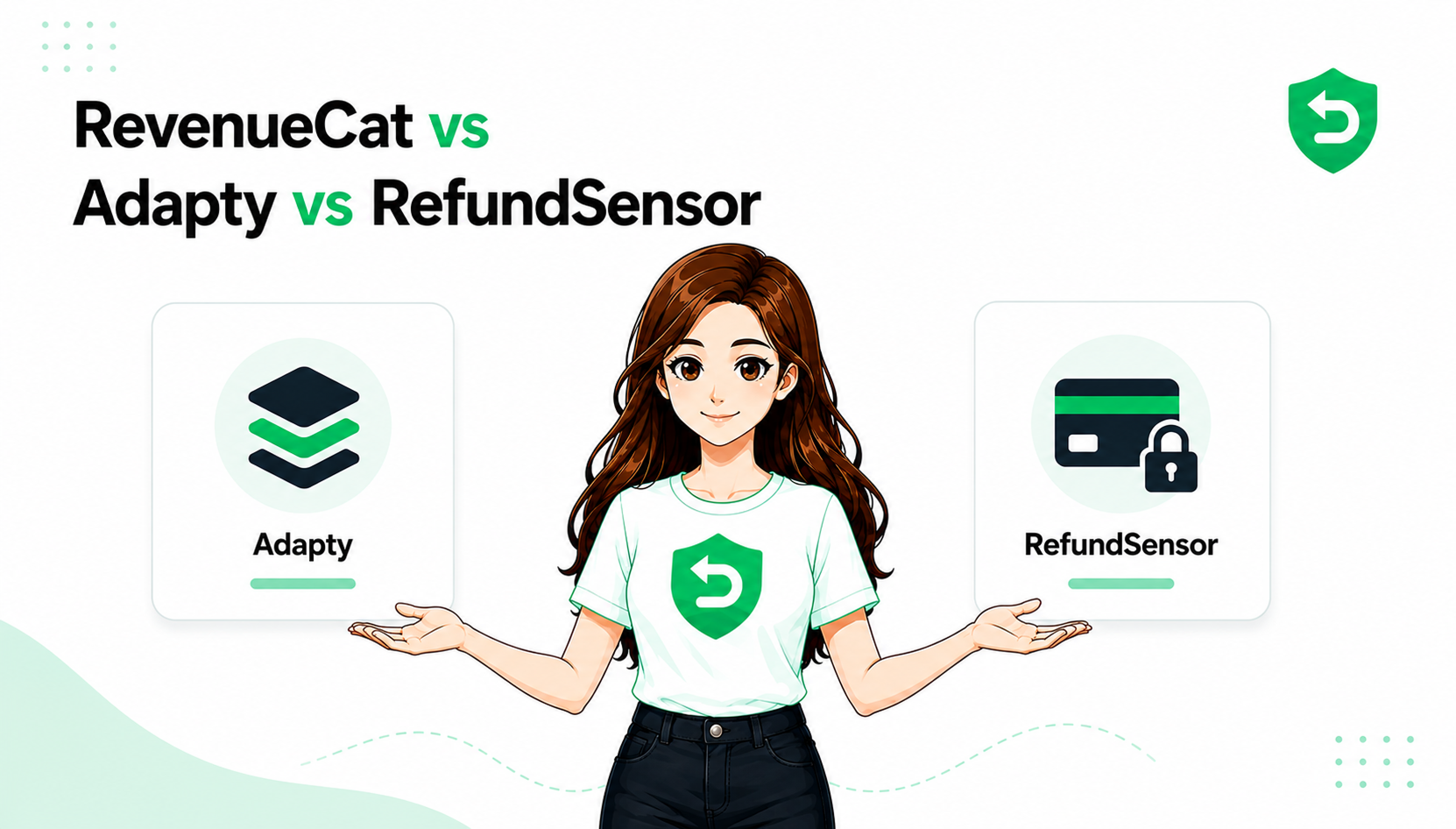
Quick answer: All three respond to Apple refund requests automatically by submitting consumption data. RevenueCat (Refund Control) and Adapty (Refund Saver) offer refund handling as one feature inside a full subscription-infrastructure platform, a great fit if you want an SDK, paywalls, and analytics all in one place. RefundSensor is a dedicated refund tool covering both Apple and Google Play, with no SDK and no code changes, built for teams that want refund recovery without adopting a whole platform. The right choice depends on whether you want refunds handled as part of your infrastructure or independently of it.
How to read this comparison
We make RefundSensor, so treat this as what it is: our view, written to be useful rather than to pretend the others are bad. RevenueCat and Adapty are excellent products, widely used for good reasons, and if the fit points their way we'll say so. The goal here is to help you match a tool to your situation, not to declare a winner, because the honest answer genuinely depends on what you're building.
Verify the specifics on each vendor's own site before you decide; all three iterate fast, and features change.
For anyone doing an Apple refund tool comparison, the important distinction is not simply whether a product handles refunds, but how the refund feature fits into your existing app infrastructure.
What all three have in common
Start with the shared foundation, because it's substantial:
All three respond to Apple's CONSUMPTION_REQUEST automatically, submitting consumption data within Apple's window so refunds aren't auto-approved by your silence.
All three report on refund outcomes granted, declined, pending so you can see what's happening.
All three require you to have obtained user consent to share consumption data; none of them removes that responsibility. (See Customer Consent & the Consumption API.)
None of them can guarantee a refund is declined Apple always decides. (See Why Did Apple Approve a Refund I Contested?.)
So the question isn't "which one responds to refunds" hey all do. It's how refund handling fits into the rest of your stack, and how far it extends beyond Apple.
RevenueCat (Refund Control)
RevenueCat is a leading subscription infrastructure platform, and its refund feature, now branded Refund Control, automatically submits usage data, spending history, and previous-refund context to Apple. RevenueCat has published strong results for it, including a Dipsea case study citing a 36% refund-rate reduction.
Strengths:
Refund handling sits right on top of the monetization data RevenueCat already holds, so it has rich context to send.
It's part of a mature, full-featured platform (SDK, paywalls, entitlements, analytics).
No extra fee for refund handling on top of the platform.
Worth knowing:
In June 2026 RevenueCat removed the "always decline" global preference, on the reasoning that blanket declines lose effectiveness and can push users toward chargebacks. This is a sound, honest position, but it's worth understanding the philosophy if you were expecting a hard "always decline" lever.
It's best value if you're already using (or willing to adopt) RevenueCat's broader platform and SDK.
For developers evaluating refund saver vs refund control, RevenueCat's approach makes the most sense when refund handling is already part of the subscription infrastructure you use.
Adapty (Refund Saver)
Adapty is another strong subscription platform, and its refund feature, Refund Saver, automates the consumption-data response with an emphasis on recovering revenue from unjustified refunds.
Strengths:
Like RevenueCat, it's backed by a full platform (paywalls, A/B testing, analytics, SDK).
Adapty publishes helpful educational content and calculators around refunds.
Positioned squarely on revenue recovery, with clear ROI framing.
Worth knowing:
As with RevenueCat, the refund feature is part of adopting Adapty's broader platform and SDK.
Its primary emphasis, like the others in this tier, is Apple-side refund handling within that platform.
Adapty's current documentation describes Refund Saver as an Apple App Store feature and notes that Google Play does not provide the same consumption-data analysis for refunds.
RefundSensor
RefundSensor is the dedicated option: a tool that does refund recovery specifically, for both Apple and Google Play, without asking you to adopt a subscription platform or change your app.
Strengths:
No SDK, no code changes, no app resubmission. You paste one webhook URL into App Store Connect; setup takes about 30 minutes.
Covers Google Play as a first-class surface, not an afterthought catching chargeback reviews inside their window and tracking voided purchases, alongside Apple. (See Google Play Refunds & Chargebacks.)
Refund-focused analytics outcomes broken down by app and by refund reason, so you can separate genuine dissatisfaction from contestable abuse.
Pricing built around refund recovery, not a percentage of your revenue, with a free tier to start.
Worth knowing:
It's a dedicated refund tool, not a full subscription platform if you also need paywalls, an SDK, and entitlement management in one place, a platform may suit you better.
Google Play refund contesting is inherently narrower than Apple's (only chargeback reviews are contestable), for all tools that's a store limitation, not a product one.
For teams comparing RefundSensor vs RevenueCat, the central question is whether you need a full subscription platform or a dedicated refund automation tool.
Side-by-side
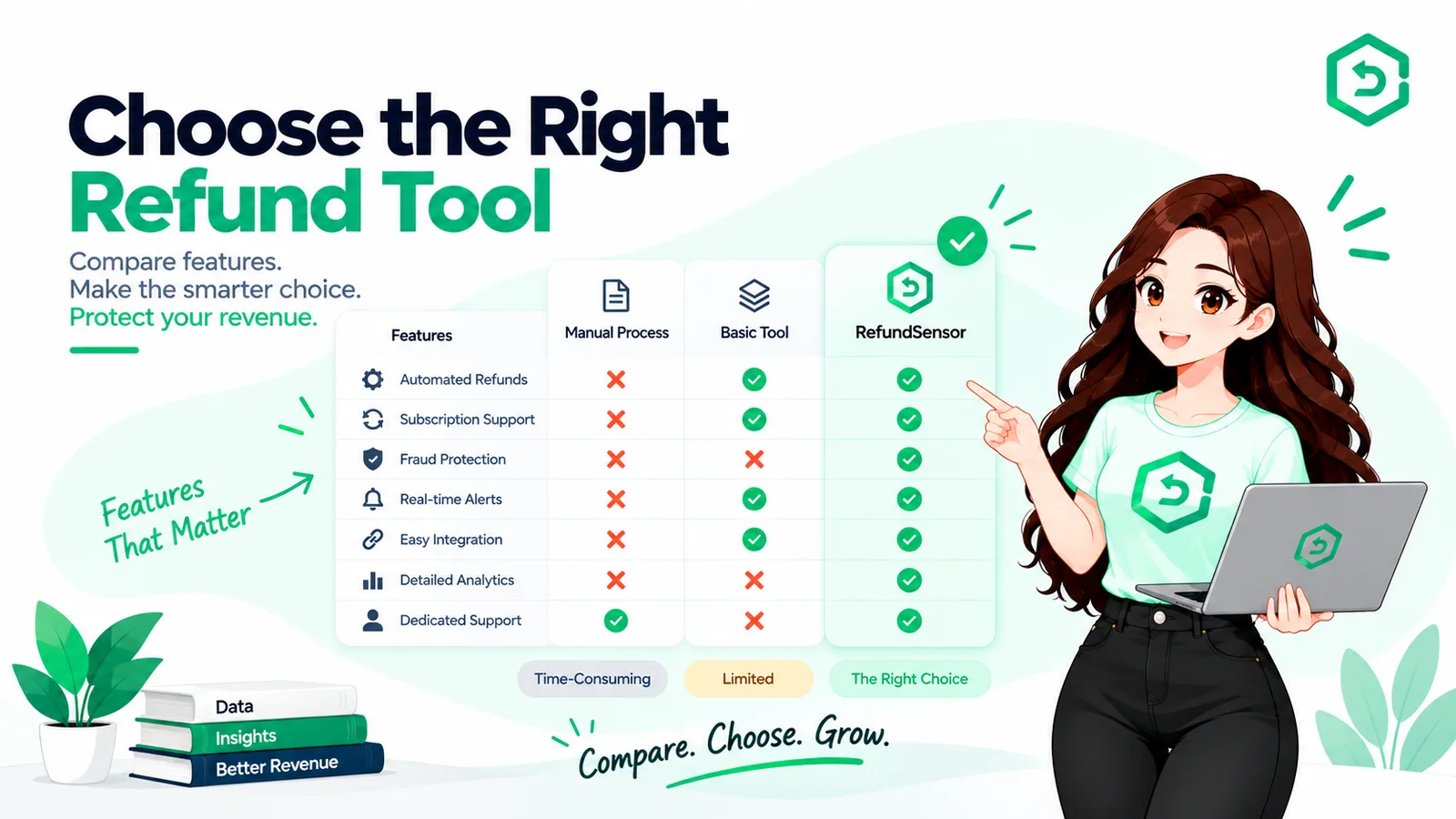
Feature | RevenueCat (Refund Control) | Adapty (Refund Saver) | RefundSensor |
Apple refund response | Yes | Yes | Yes |
Google Play refund & chargeback handling | Platform-dependent | Platform-dependent | First-class support |
Requires SDK or code changes | Yes (platform SDK) | Yes (platform SDK) | No |
Part of a broader platform | Yes, full platform | Yes, full platform | Dedicated refund tool |
Refund analytics by reason | Yes | Yes | Yes |
Setup effort | Platform integration | Platform integration | About 30 minutes, one webhook URL |
Best for | Teams wanting all-in-one subscription infrastructure | Teams wanting all-in-one subscription infrastructure | Teams wanting dedicated refund recovery |
Verify current specifics on each vendor's site, features and pricing change.
How to choose
Cut through it with one question: do you want refunds handled as part of your subscription infrastructure, or independently of it?
For a refund automation comparison, this is the key decision: choose the broader subscription platform if you need its other infrastructure, or choose a dedicated refund recovery platform if refunds are the specific problem you're trying to solve.
Choose RevenueCat or Adapty if you're building on (or want to build on) a full subscription platform you'll get refund handling alongside paywalls, an SDK, and analytics, which is genuinely convenient when you want one system for everything. Between the two, the choice usually comes down to the broader platform fit, not the refund feature alone.
Choose RefundSensor if you want refund recovery without adopting a platform or touching your app's code, if Google Play coverage matters to you as much as Apple, or if you'd rather pay based on refund recovery than a share of revenue. It's the focused tool for teams whose problem is refunds, not subscription infrastructure.
There's no universally correct answer there's the one that fits your stack. If you already live in RevenueCat, its refund feature is the path of least resistance. If you don't want a platform in the loop, a dedicated tool is.
For teams looking for the best refund automation tool for apps, compare setup requirements, supported stores, refund analytics, pricing, and whether you need a complete subscription infrastructure platform.
Want refund recovery without adopting a whole platform? RefundSensor handles Apple and Google Play refunds with no SDK and no code changes about 30 minutes to set up, free tier to start. Start free →
Frequently asked questions
All three auto-respond to Apple refund requests with consumption data. RevenueCat and Adapty offer it as a feature within a full subscription platform (requiring their SDK); RefundSensor is a dedicated refund tool covering Apple and Google Play with no SDK or code changes.
No. All submit data to influence Apple's decision, but Apple always decides. Any tool promising guaranteed declines is overstating what's possible.
RefundSensor treats Google Play as a first-class surface, handling chargeback reviews and tracking voided purchases. On all platforms, Google Play contesting is limited to chargeback reviews, that's a store constraint, not a tool one.
For RevenueCat and Adapty, refund handling comes with adopting their platform SDK. RefundSensor requires no SDK or code changes, one webhook URL into App Store Connect.
RevenueCat removed the global "always decline" preference in June 2026, reasoning that blanket declines lose effectiveness and can push users toward chargebacks. It's a defensible position about how Apple treats refund preferences as advisory signals.