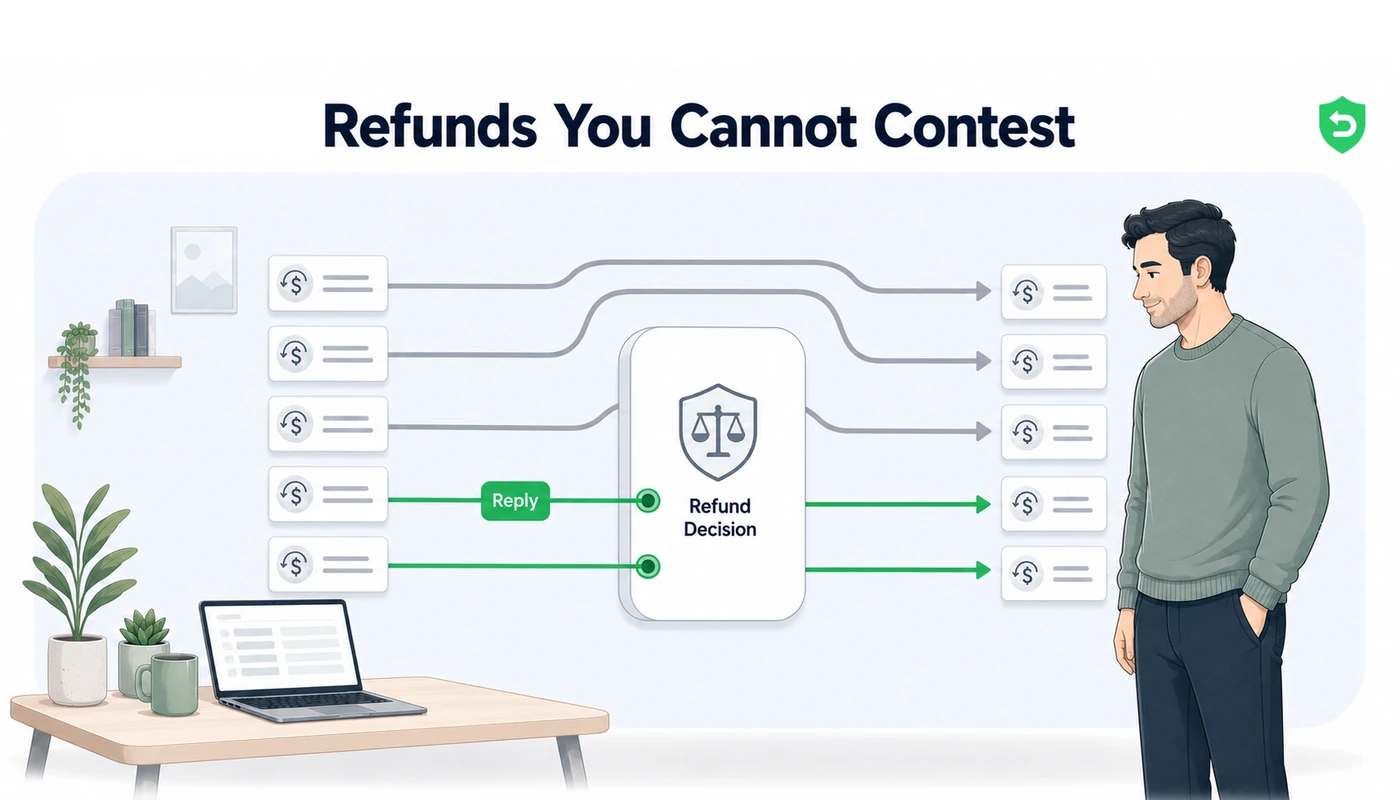
Two flows in the entire refund landscape pause to collect your evidence. Apple's consumption request is one, Google Play's chargeback review the other. The 48-hour Play refund, anything a support agent grants, voided purchases, trials that expired unacknowledged: all resolved in your absence. Here is the complete map, separating what you can stop from what you can only file.
Key takeaways
Between both platforms, developers get a voice in precisely two refund flows: Apple's CONSUMPTION_REQUEST on a 12-hour deadline, and Google Play's chargeback review on a 24-hour one.
Play's 48-hour self-service refund runs entirely on Google's policy. No developer input exists, no evidence channel exists, and no appeal exists.
Whatever a support agent at either company grants is settled permanently. Once a refund has been decided, no appeal route exists at either store.
Purchases your app leaves unacknowledged for three days get refunded and revoked by Google automatically. That is your integration failing rather than a customer choosing, and it is entirely preventable from your server.
App Store card chargebacks get settled between Apple and the issuing bank. On Play, orders dated after August 3, 2026 push the purchase price plus bank fees onto developers.
Seeing a store refund in your ledger does not mean you lost anything. It means no review window ever existed. Measure your protection against contestable cases exclusively.
Refunds arriving against your app raise one question that matters more than the reason: was your side ever requested. Across the App Store and Google Play, exactly two moments exist where a store stops, turns toward the developer, and asks for evidence ahead of deciding. Everything else concludes without you regardless of how well your integration is built. Telling the categories apart changes how your own numbers should read, because refunds nobody consulted you about were never contests in the first place.
The only two flows that want your input
Apple's is CONSUMPTION_REQUEST. It fires where the disputed item was either a consumable purchase or an auto-renewable subscription, sending a notification to your server and then holding for up to 12 hours awaiting consumption data: delivery confirmation, the proportion consumed, and whether you would rather see the refund approved or refused. The decision stays Apple's, but your evidence is a documented input to it.
Google's equivalent came later and reaches less far. Disputed purchases produce a pendingRefundReviewNotification, opening a 24-hour period to reply through the Review Refund API carrying delivery state, consumption status, and evidence of usage. Google describes this API in plain terms as a mechanism helping it spot and contest illegitimate chargebacks for you.
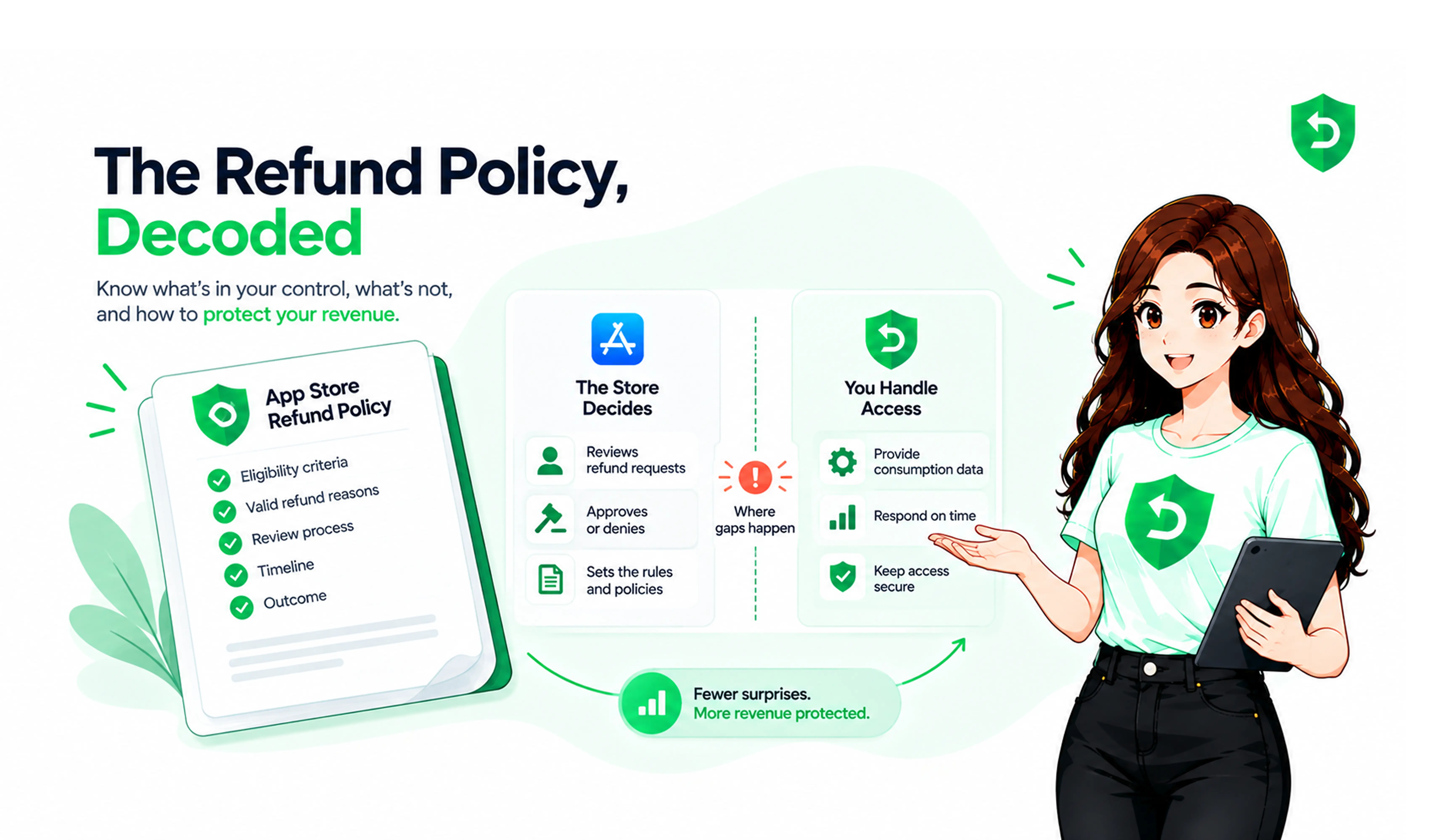
Apple's consumption request runs on the App Store with a 12-hour deadline. You supply whether the item shipped, how far it was used, and the outcome you would prefer.
Google's chargeback review runs on Google Play with a 24-hour deadline. You supply the fulfilment state, how far consumption progressed, and your logged usage.
Nothing else belongs on that list. Refunds arriving by any other route came with no window during which anything you submitted could have altered the result.
Google refunds that skip you entirely
Most misread of all is the 48-hour self-service refund. Anyone whose purchase is under 48 hours old can request a refund directly through Google Play, and Google resolves it against its own policy, usually inside a few days. Developers are neither consulted nor informed until the refund materialises as a voided purchase. That is store policy behaving exactly as intended, not a hole in your defences.
Past the 48-hour mark, Google's help pages send customers toward the developer instead. Refunds you then grant from Play Console are simply customer service, entirely your judgement. Refunds Google support grants regardless are settled, appeal being unavailable.
There is also voidedPurchaseNotification, which functions as the record-keeping stream. Refunds from family managers, revocations Google initiated over abuse, partial refunds tied to quantity, and refunds you issued yourself in Play Console all land there. It reports rather than asks, and nothing arriving in it can be answered.
Refunds you caused yourself: the three-day trap
One category of Google refund warrants separate treatment, because no customer decision is involved anywhere in it. Apps that fail to acknowledge a purchase within three days cause Google to refund the buyer and revoke the purchase automatically. Play Billing documentation states this without ambiguity, and in production the revocation arrives almost exactly at 72 hours.
They appear in the voided stream carrying unacknowledged_purchase as the reason, frequently on free trials where nobody reopened the app so the acknowledgement call never executed. What is lost is usually a first billing you never had the chance to charge. Contesting them is impossible, but removing them completely is not: acknowledge from your server as soon as the purchase notification arrives, rather than depending on someone launching the app. Refund Sensor performs this automatically once auto-acknowledge is enabled.
Apple's silent refunds
Every App Store refund is Apple's own decision. Consumption requests are input, never votes, and Apple's verdict closes the matter. REFUND means the money has gone, REFUND_DECLINED means it stayed. No appeal endpoint exists, no escalation route exists, and no second window opens.
Two Apple situations collect no evidence whatsoever. Refunds on purchase types falling outside the consumption-request flow get decided purely on the customer's claim and their account history. And card chargebacks against App Store purchases are settled strictly between Apple and the cardholder's bank, with developers never seeing a case or having any route into one.
August 3, 2026 changes the arithmetic on Google
Google has announced that orders placed after August 3, 2026 carry shared chargeback costs. The developer's portion becomes the purchase price with Play's service fee deducted, and the bank's chargeback fees added on top of that. Google's exposure is limited to the service fee it collected. That same announcement points developers toward the Review Refund API as the instrument for pushing back, by supplying enough evidence for Google to contest illegitimate disputes.
The single contestable Google flow therefore becomes financially load-bearing. Losing a chargeback was previously mostly Google's expense. From that date, every chargeback you leave unanswered costs you revenue and fees both.
Reading your dashboard properly
What follows practically is a bookkeeping discipline: separate refunds into contestable and store-issued, then assess your protection using only the former.
Save rate applies exclusively to contestable cases, meaning consumption requests and chargeback reviews answered against a clock.
Store refunds deserve their own ledger. They carry useful information about products, countries, and stated reasons, but deliver no verdict on how well you are defended.
Unacknowledged purchases are the one store side figure demanding action, since server-side acknowledgement prevents them outright.
Keep watching the chargeback column as August 2026 approaches, because evidence quality on that flow is about to acquire a price.
Refund Sensor organises its dashboard along exactly those lines: refund requests and chargebacks displayed prominently alongside their outcomes, with store refunds kept in a separate tab, recorded so nothing is missing from your ledger.
Where these rules are documented
Apple: requesting a refund for apps or content bought from Apple
Apple: Send Consumption Information in the App Store Server API
Google Play Billing: real-time developer notifications reference
Google Play Billing: one-time purchase lifecycle and the three-day rule
Google Play Console Help: refund protection and chargeback cost responsibility
Google Play Billing: refund and chargeback suggestions through the Review Refund API
Frequently asked questions
No. Decided refunds have no appeal route at either store. Apple's post-consumption-request verdict is final, as are Google support decisions and self-service refunds. Evidence submitted inside the two review windows, before any decision, is the only influence available.
No, they are unrelated. The 48-hour refund is Play Store policy administered by Google with no developer involvement whatsoever. A chargeback is something the customer raises with their bank. Only the chargeback route offers developers an evidence channel, via the 24-hour Review Refund API window.
Nearly always because acknowledgement never happened. Purchases left unacknowledged beyond three days get refunded and revoked by Google automatically. It reflects an integration failure rather than a customer request, and acknowledging from your server removes it entirely.
Not at all. Those come straight from Apple or Google with no review window attached, meaning nothing was ever available to contest. Refund protection describes consumption requests and chargeback reviews, the two flows carrying an evidence window and a deadline.
Chargeback costs get split on Play orders dated after that day. Your side is the purchase price with Play's service fee taken out, and the bank's chargeback fees added. Google's side is the service fee alone. Evidence filed through the Review Refund API becomes the primary lever against illegitimate disputes.