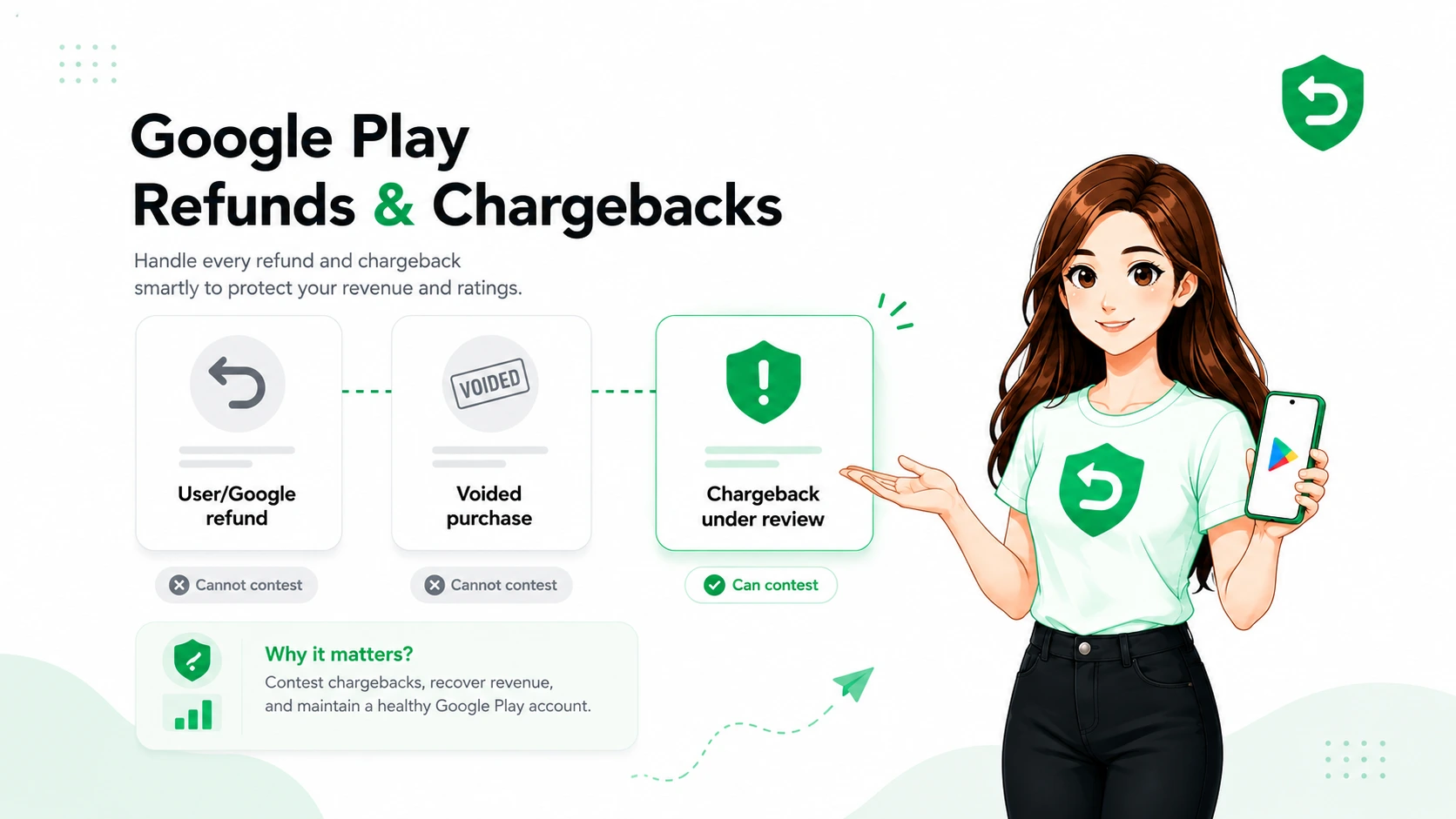

Google Play and Apple handle refunds in fundamentally different ways. Learn why Google doesn't use Apple's model and what those differences mean for developers, subscriptions, revenue recovery, and user experience.
If you ship an app on both stores, you have felt this. A Google Play refund behaves nothing like an Apple one. Apple keeps almost every decision in-house. Google hands a big chunk of the job to you, the developer. Same problem, two very different setups.
So why the split? It is not laziness or a copy that went wrong. It is a choice rooted in how each company built its store. If you want the practical side of surviving that choice, our Google Play refund defense guide covers the day-to-day. This post digs into the why.
I will keep it plain, back the policy claims with official docs, and flag clearly where my own analysis starts. No fluff, no generic refund walkthrough. Just the real reason the two models look so different.
Key Takeaways
Google gives buyers a short self-serve window, then points most refunds to the developer. (documented)
Apple keeps refund decisions centralized and rarely lets developers act. (documented)
The gap comes from Google's open, developer-run platform DNA versus Apple's closed, controlled one. (analysis)
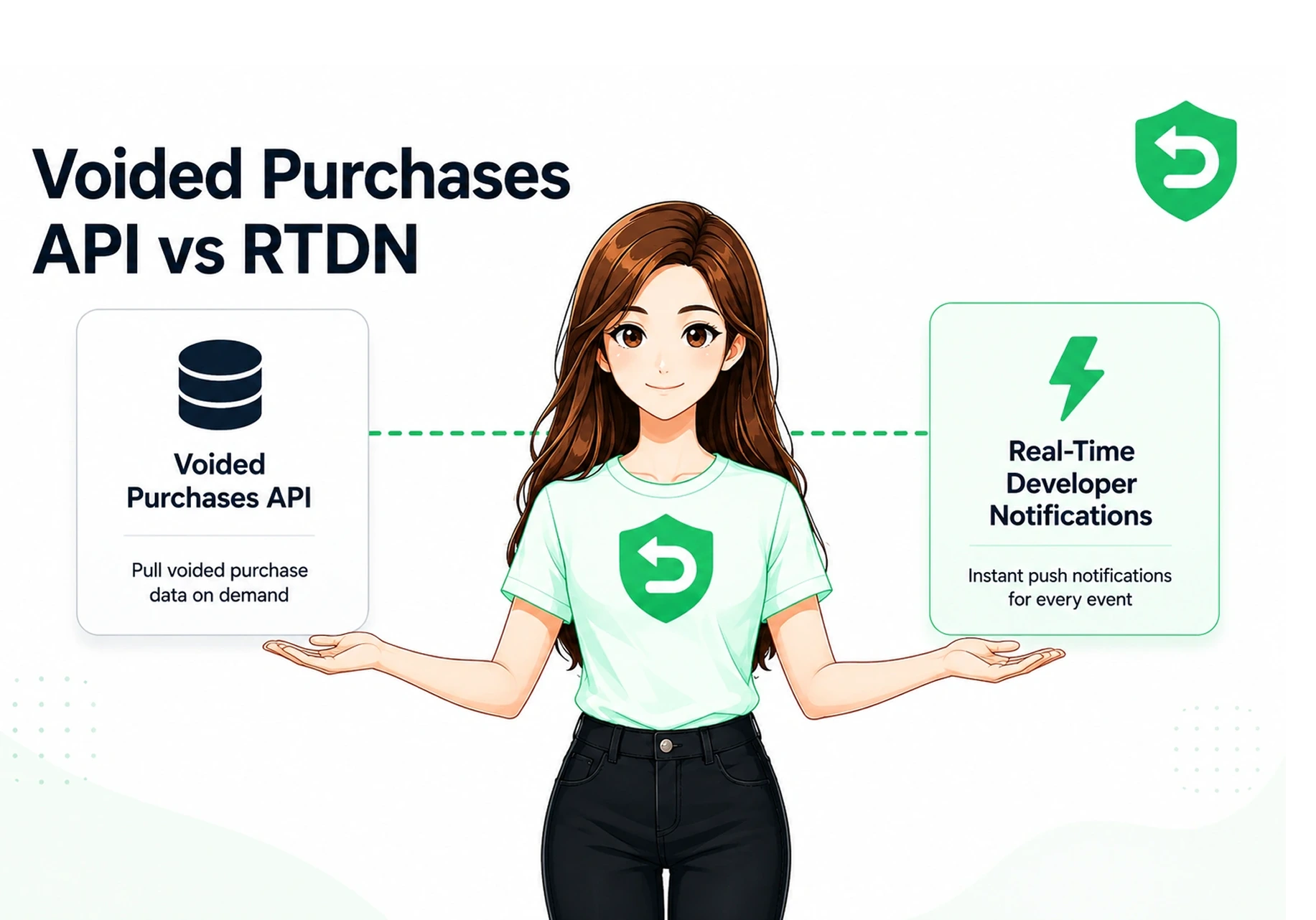
Google gives you real tools: the Voided Purchases API and Real-time Developer Notifications. (documented)
More control means more responsibility, which is why refund tooling matters on Android. (analysis)
What Is Google's Refund System?
Direct answer: Google's refund system is a shared one. Google handles a short self-serve window right after purchase, usually 48 hours for apps and games. After that, Google points buyers to the developer, who can refund based on their own policies and the law. Google is more referee than judge.
This matters because most apps on the Play Store come from third-party developers, not Google. So Google built a system that assumes the developer is in the loop, and that single assumption shapes the whole Google Play refund policy. Apple assumes the opposite. It acts as the merchant of record and keeps the buyer talking to Apple, not you.
How Does Google Play Handle Refund Requests?
Direct answer: The Google Play refund process starts with Google. Within about 48 hours, Google can approve a refund through its own self-serve flow. Past that window, Google usually tells the buyer to contact the developer. Google also shares some refund data with developers so they can act.
The buyer side (documented)
The user opens their Google Play order history and finds the purchase.
Within about 48 hours, they can click "Request a refund" or "Report a problem."
Google reviews and usually decides within a day, though it can take up to four days.
After 48 hours, Google often points the user to the developer for help.
For charges the user never made, Google allows reporting for up to 120 days.
The developer side (documented)
This is where Google Play splits hard from Apple. Google expects your server to know when a purchase gets voided, and to react. It gives you two official tools for the job. When a user voids a purchase, Real-time Developer Notifications can ping your backend right away. The Voided Purchases API then lets you pull a list of refunded, canceled, or charged-back orders so you can revoke access if needed.
How Is Google's Refund System Different From Apple's?
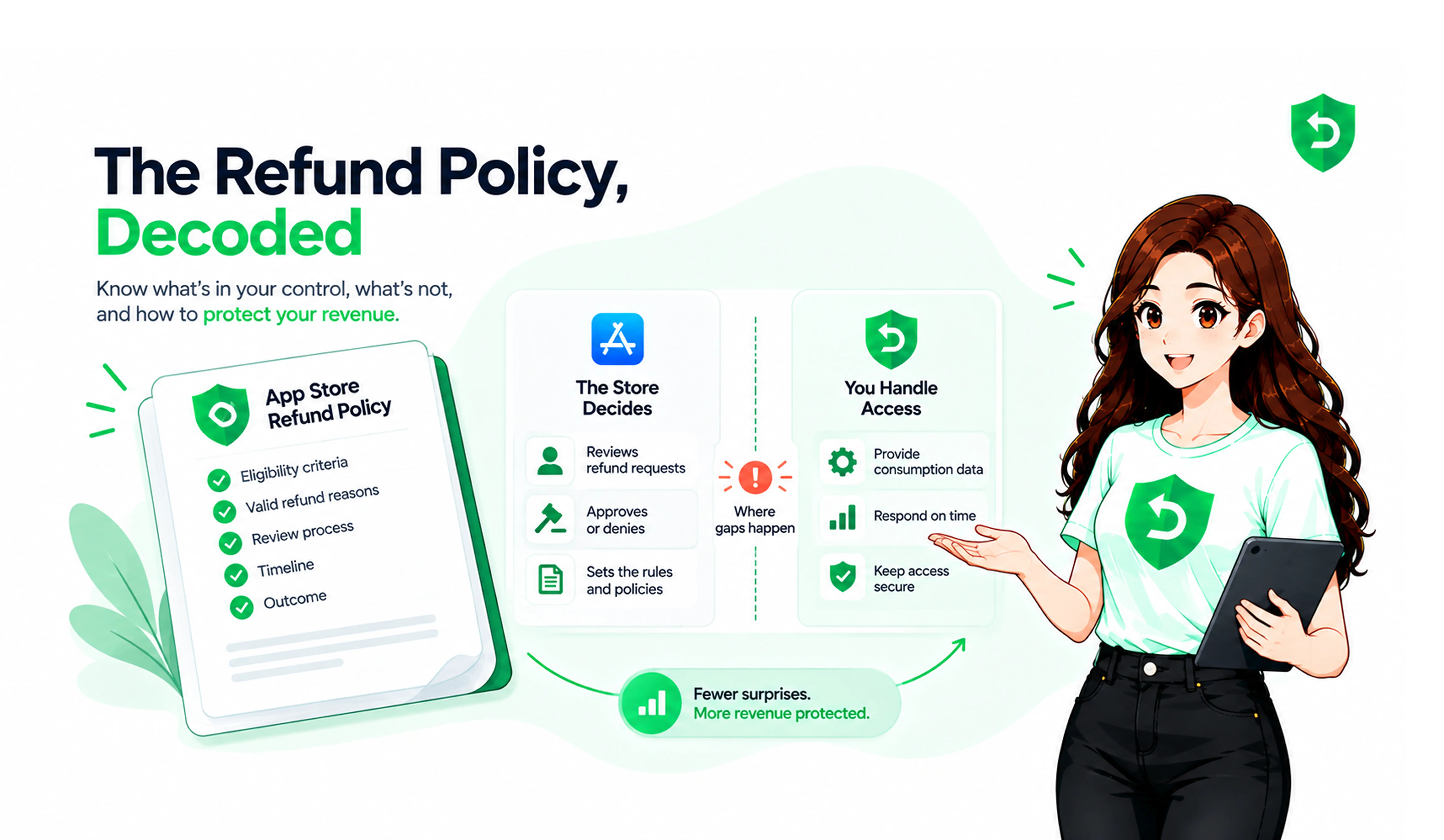
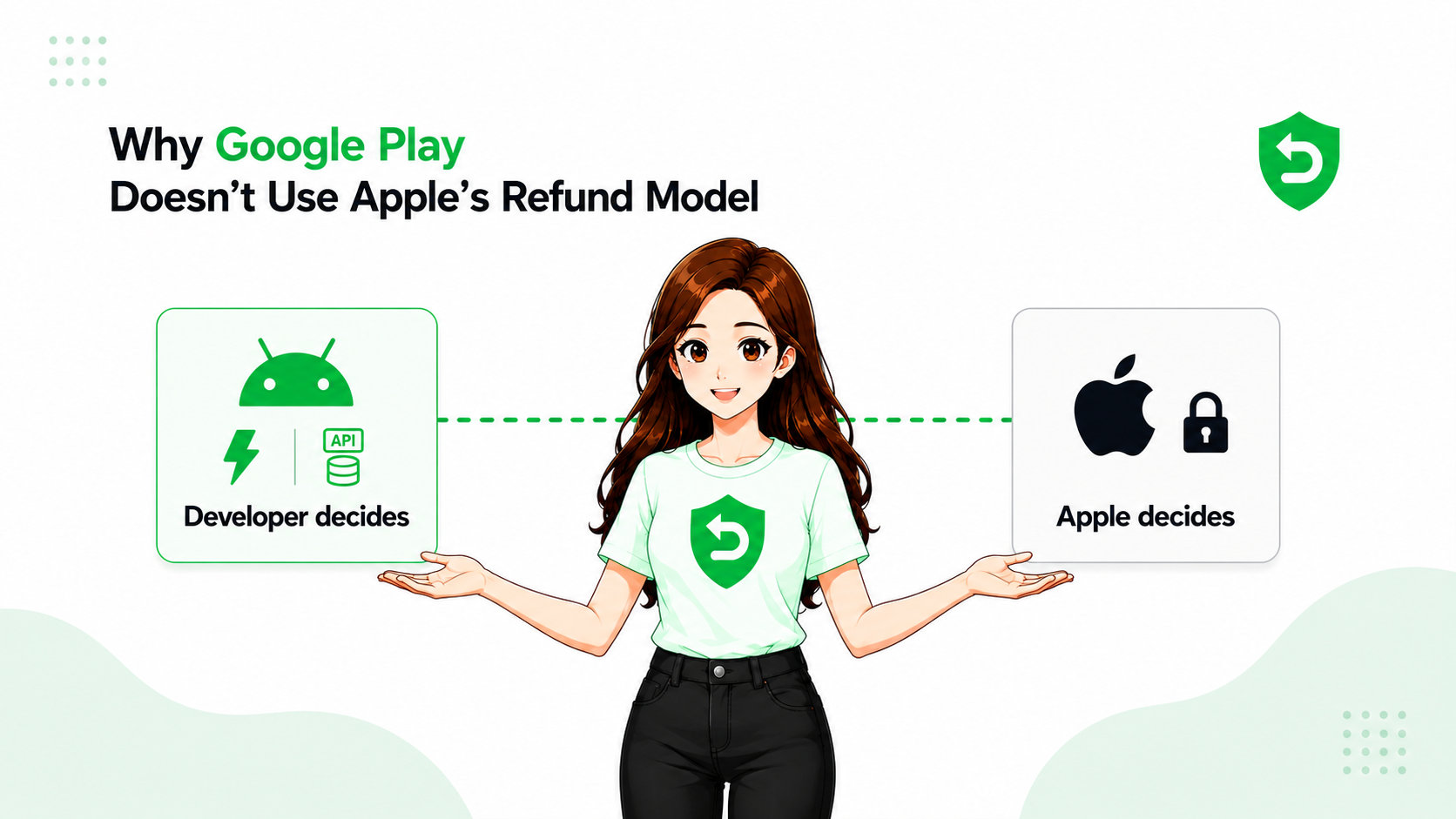
Direct answer: Apple centralizes, Google delegates. Apple reviews refunds itself and gives developers a short data-only window through the CONSUMPTION_REQUEST notification. Google hands developers real power to refund, revoke, and manage entitlements after the first window closes. Same goal, opposite balance of control.
The table below lays out the workflow side by side. Treat the timing as general guidance from official help pages, since both stores tweak the details over time.
Step | Google Play | Apple App Store |
|---|---|---|
Where the buyer starts | Google Play, then the developer | Report a Problem (Apple only) |
Self-serve window | About 48 hours for apps | No fixed public window |
Who decides after that | The developer | Apple |
Developer signal | RTDN + Voided Purchases API | CONSUMPTION_REQUEST notification |
Developer power | Refund and revoke access | Send data only |
Merchant of record | Developer in many regions | Apple |
Table 1: Google Play vs Apple refund workflow. Timing reflects official help pages and can change.
The Real Reason Google Play Doesn't Use Apple's Refund Model
Direct answer: Google Play does not copy Apple because the two stores were built on opposite beliefs. Android is open and developer-first. Google designed refunds to match that, giving developers control and responsibility. Apple is closed and buyer-first, so it kept refunds locked to itself. The refund model simply follows the platform DNA.
Here is my read as a founder, labeled as analysis. Apple's brand is a walled garden. Everything feels smooth because Apple controls it all, including your refunds. That control is the product. Handing developers refund power would chip away at the promise that Apple always has the buyer's back.
Google went the other way from day one. Android invites developers to run their own show. Google set baseline rules, then trusted developers to handle the rest. A developer-run refund flow fits that world.
There is a money angle too. On Google Play, the developer is often the merchant of record, which ties them closer to the sale and the refund. On Apple, Apple usually sits in that seat. Who owns the sale tends to shape who owns the refund.
Business Reasons Behind Google's Refund Model
Direct answer: Google delegates refunds to keep Play fair, scalable, and in line with the wider app industry. It also cuts Google's support load. The following points are my analysis, grounded in Google's public direction.
Fairness at scale. With millions of third-party apps, Google cannot judge every case well, so developers who know their product decide.
Industry alignment. Google has said it wants Play in line with the broader app store industry, which leans developer-run.
Lower support cost. Fewer refund tickets for Google means a leaner store operation.
Developer accountability. If you own the refund, you have a reason to build a product that earns fewer of them.
Technical Challenges Behind Google Play Refunds
Direct answer: A developer-run model needs solid plumbing. Your server has to hear about a refund, find the right order, and pull access without wrecking the user experience. Google provides the notifications and APIs, but wiring them up correctly is on you. This section is analysis based on how the tools behave.
Timing. Refunds can land at any hour, so your backend has to listen all the time, not on a schedule.
Right order, right user. You must match a voided purchase to the correct entitlement before you revoke anything.
Acknowledgement traps. If a purchase is not acknowledged in time, Google auto-refunds it, so silent bugs cost real money.
Fair revocation. Yanking access too aggressively can punish honest users, so the logic needs care.
How Google's Refund Model Affects Developers
Direct answer: Google gives developers more control and more homework. You can refund, revoke access, and claw back items, but only if your systems catch the events. Miss them and you leak revenue or annoy paying users. Control is a gift with a bill attached.
In practice, this means a Google Play developer refund is only as good as the automation behind it. A refund that fires with no matching revoke can hand a user free access forever. A revoke that hits the wrong account burns a loyal customer. Our breakdown of the Voided Purchases API workflow shows where teams usually trip. On Android, refunds are an engineering job, not just a support one.
How Google's Refund Model Affects Users
Direct answer: Users get a fast, no-questions window early, then a slower, developer-led path later. That can feel great inside 48 hours and frustrating after, especially if a developer is slow to reply. The experience depends a lot on which developer built the app.
This is the human cost of delegation, labeled as analysis. A buyer who misses the window now depends on a stranger's support inbox. Good developers make it smooth. Bad ones make it a wall. Apple feels more uniform because one company answers every time.
Could Google Play Build a Better Refund System?
Direct answer: Probably, yes. Google could keep its developer-first model while adding clearer timelines, better dashboards, and stronger default tooling so smaller developers are not left guessing. The goal would be more support, not more control taken back by Google. This section is my opinion.
Responsibility | Google Play (developer) | Apple App Store (Apple) |
|---|---|---|
Decide most refunds | Developer after 48 hours | Apple almost always |
Detect a refund | Developer via RTDN | Apple internal |
Revoke access | Developer via API | Handled by Apple |
Talk to the buyer | Often the developer | Apple |
Build the tooling | Developer | Not needed |
Table 2: Google Play vs Apple developer responsibilities. Google shifts far more onto the developer.
Final Thoughts
So, the real reason Google Play does not use Apple's refund model is simple once you see it. Each store built refunds to match its own soul. Apple stays closed and keeps control. Google stays open and shares it. Neither is wrong. They are just different bets on who should own the buyer relationship.
For developers, the lesson is clear. On Android, refunds are yours to manage, so the tooling around them is not optional. If you want a head start, our Google Play refund defense overview maps out what to automate first. Own the process before it owns your revenue.
Where These Policies Are Documented
For trust and accuracy, here are the official sources behind the policy points in this article. Always check these for the current rules, since both stores update them over time.
Google Play Help, refund policies and how to request a refund. support.google.com/googleplay
Google Play Billing documentation, purchase lifecycle and Real-time Developer Notifications. developer.android.com/google/play/billing/lifecycle
Google Play Developer documentation, Voided Purchases API. developers.google.com/android-publisher/voided-purchases
Apple
Apple Support, request a refund for apps or content. support.apple.com/en-us/118223
Apple Developer documentation, App Store Server API and refund handling. developer.apple.com/documentation/appstoreserverapi
Own the process before it owns your revenue. RefundSensor catches every Google Play voided purchase and chargeback review in real time, and does the same for Apple, all in one dashboard, no code changes. Start free
Frequently asked questions
Google Play gives developers more control over refunds, while Apple manages most refund decisions itself. This reflects Google's open ecosystem and Apple's centralized approach.
Google Play typically allows users to request a refund within about 48 hours of purchasing an app or game. After that, refund requests are usually handled by the developer.
After the initial refund window, developers generally decide whether to issue a refund based on their policies and applicable laws, although Google may review certain cases.
The Voided Purchases API lets developers identify refunded, canceled, or charged-back purchases so they can revoke access and keep user entitlements accurate.