
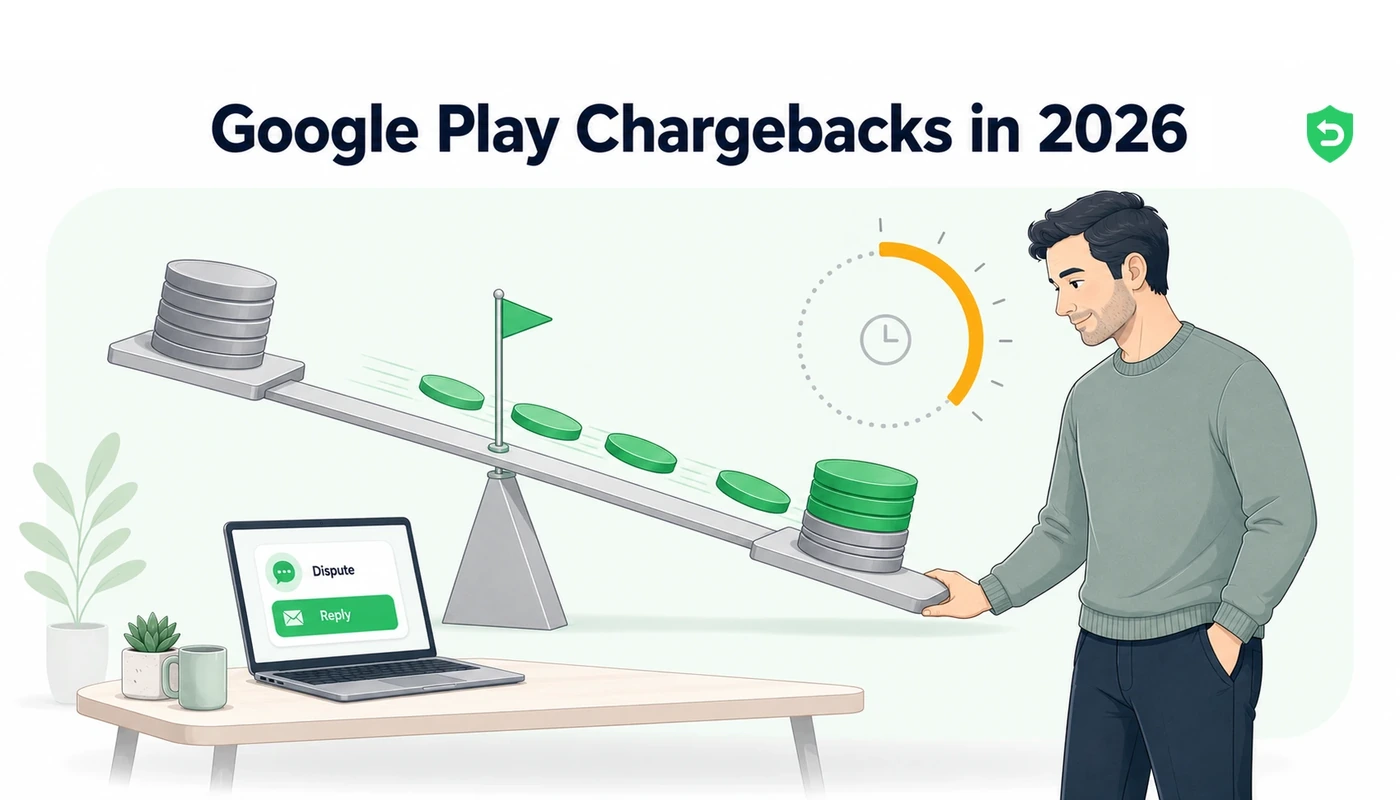
Chargeback responsibility on Play purchases changes for orders placed after August 3, 2026. Losses that Google used to absorb become yours: the purchase price less Google's service fee, with the bank's fees added. Arriving alongside that cost is something developers never previously had, a 24-hour window in which evidence can actually be submitted.
Key takeaways
Lost chargebacks come out of developer revenue, calculated as the purchase price minus Play's service fee, plus whatever the bank charges in chargeback fees.
A PendingRefundReviewNotification reaches you over RTDN, and the clock on it runs for 24 hours.
What you can attach spans the share consumed plus a batch of usage records, 1,000 being the ceiling, each stamped with a time, an originating IP, and a location.
Whatever you submit first is what counts. Anything sent afterwards gets discarded without complaint.
Bank fees do not scale with price, so on cheap products the fee alone can exceed what the customer paid, which makes staying silent expensive.
A voice in the process, lasting exactly one day
Contesting a chargeback simply was not possible before this. What replaces that gap borrows heavily from Apple's consumption request design. Disputes needing review generate a notification, and from its arrival you have precisely 24 hours to file a verdict, approve, decline, or neutral, together with whatever evidence supports it, through the orders.reviewrefund API. Google then takes that material and argues the case with the bank for you.
Who absorbs the chargeback used to be Google. After August 3, 2026, it is mostly the developer.
Your direct cost used to be nothing. After the change, it is the purchase price less the service fee, plus the bank's fees.
What Google still covers used to be all of it. After the change, it is only the cost of its own service fee.
Whether you can contest it used to be no. After the change, yes, within a 24-hour evidence window.
What replying actually requires
Every response has to echo the pendingRefundToken back. Tying a chargeback to an actual user depends on obfuscated account IDs having been set during purchase, and without them, matching a dispute to somebody in your records becomes guesswork.
The evidence you can attach includes:
Your verdict, alongside whether sample content was available
A consumption percentage expressed in milliunits, where 45200 represents 45.2%
As many as 1,000 usage events, each carrying a timestamp, an IP address, a coarse location, and a description running up to 5,000 characters
Worth knowing before you build this: only your opening response is recorded. Later calls get discarded silently while still returning OK, so anything incomplete on the first attempt stays incomplete permanently.
Doing the arithmetic on staying quiet
Chargeback fees charged by banks are flat, entirely indifferent to what the product cost. Cheap consumables can therefore generate a fee larger than the sale itself. Layer on the compute and storage already spent serving that purchase and the shortfall compounds. Using the API remains technically optional, but since the loss lands on you either way, opting out means absorbing it without argument.
Preparing before August arrives
Enable RTDN for every notification type, because review requests arrive over the topic your subscription events already use.
Make certain an obfuscated account ID goes onto each purchase, without exception.
Work out where your usage evidence actually lives, meaning the timestamps and IP addresses you would need to cite.
Automate the whole response path, fallback behaviour included, ahead of the deadline rather than after it.
Refund Sensor handles that pipeline end to end, filing an evidenced response inside the window without anyone needing to watch a queue.
Where these rules are documented
Frequently asked questions
August 3, 2026, and only for orders placed from that point. Anything bought earlier stays under the previous rules, so the financial effect arrives gradually rather than all at once.
The purchase price minus Play's service fee, with the bank's chargeback fees added on top. Google's remaining exposure is the service fee it charged.
Your verdict of approve, decline or neutral; a flag covering whether sample content existed; the share consumed expressed in milliunits; and a batch of usage records, 1,000 at most, where each entry logs when it happened, which account and IP it came from, a coarse location, and a free-text description.
No. Only your first response is stored, and everything after it is ignored, though the API still returns OK.
It is not, but lost chargebacks are billed to you regardless, so skipping the sole mechanism for contesting them amounts to accepting the losses without comment.